
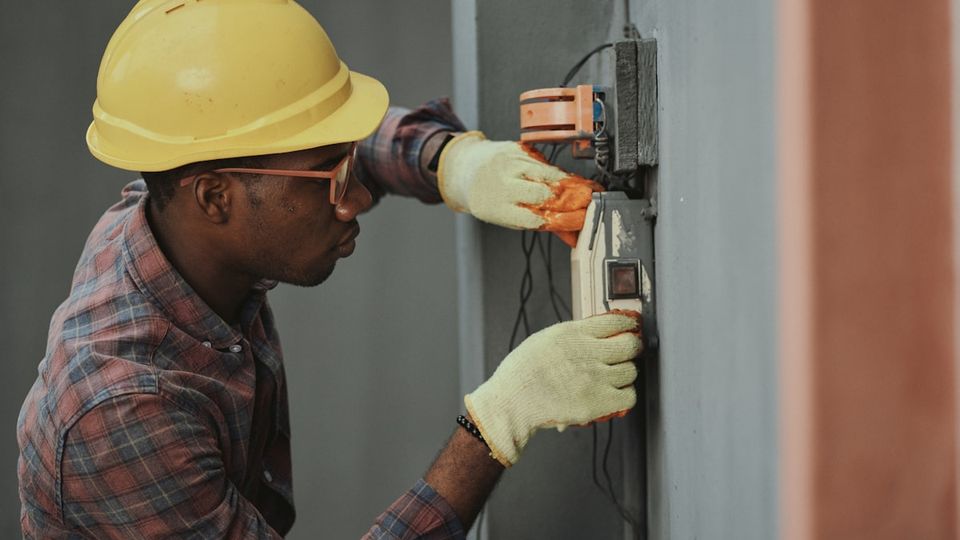
We built Beside for people who do real work with their hands. Electricians are some of the busiest owners on our platform, and the pattern is consistent: the calls that matter most come in when you're least able to answer them.
| What it does | How it helps an electrician |
|---|---|
| Answers calls 24/7 in your voice | Customers hear you, not a generic bot |
| Books appointments against your calendar | Jobs land on your schedule while you work |
| Qualifies leads and flags emergencies | Panel upgrade vs. flickering light, sorted before you call back |
| Transcribes and summarizes every call | Daily recap replaces digging through voicemail |
| One flat monthly price | No per-call billing that punishes busy months |
If you already know missed calls are costing you jobs, your line answers tonight, in your voice.
The call that gets missed (and where it goes)
You're wrist-deep in a 200-amp panel swap. The homeowner's breaker tripped again, you've got live circuits to isolate, and your phone starts buzzing in your pocket. You hear it. You can't answer it. By the time you pull your gloves off and check, the caller has moved on.
Here's what happens on the other end of that call. ServiceTitan looked at booking rates across more than 3,000 trade businesses and found electrical shops turn 41% of their incoming calls into booked jobs. Shops with fewer than five techs manage 24% (Source: ServiceTitan, Data Report: Average Call Booking Rates). Not every one of those lost calls rang out unanswered — some get picked up and still go nowhere. But you can't book a call you never answered.
What a missed call actually costs an electrical business
The call fee itself is the small money: $100 to $200 to come out and look (Source: Housecall Pro electrical pricing guide). The real money is what the call turns into. The homeowner who calls about a tripping breaker today is the same homeowner who needs a panel upgrade — $518 to $2,191, averaging $1,345 (Source: HomeAdvisor) — and an EV charger install after that, at $1,200 to $3,000 (Source: Recharged).
At a moderate call volume, an electrician missing five or six calls a week leaves $27,000 to $33,000 a year in revenue on the table (Source: Market Minds Global). That number only counts the first appointment. It doesn't count the panel upgrade that would have followed, the referral to the neighbor, or the commercial bid from the builder who called once and moved on.
An answering service that bills per call taxes you for being busy. The months when your phone rings most are the months your bill climbs highest.
One missed panel-upgrade call is worth $1,345 on average. Beside is $199.99 for the year.
What an electrician actually needs from an AI receptionist
The lead-response research is clear: contacting a lead within five minutes makes you 21 times more likely to qualify it than waiting thirty (Research from MIT and InsideSales.com, via Rework). That window closes while you're finishing the job.
You need something answering your phone. The real test is whether it does enough to matter:
The owners we work with tell us the forwarding setup is the thing that surprised them: it takes a few minutes, and if you decide Beside isn't right, you turn it off. Your number stays yours.
How Beside works for electricians
A customer calls your line. You're on a ladder replacing a fixture. Beside picks up in your cloned voice, greets the caller the way you would, asks what they need, and qualifies the call. Panel upgrade quote? It books an appointment against your calendar and collects the address. Sparking outlet? It flags the call as urgent and sends you a push notification.
After the call, you get a transcript, a plain-language summary, and a list of action items. At the end of the day, a recap pulls together everything that happened on your line. You're done replaying voicemails and scribbling notes on the dashboard.
Beside answers in your cloned voice and carries a 4.8-star rating from over 8,900 App Store reviews across 25,000+ paying owners. It connects to about twenty tools, including HubSpot, Salesforce, Pipedrive, Monday CRM, QuickBooks, Google Sheets, Slack, and Zapier. Field-service platforms like ServiceTitan, Jobber, and Housecall Pro are not integrations today — if your scheduling lives in one of those, Beside still answers the call, books to your calendar, and sends you the transcript.
"Not being stressed about forgetting anything a customer wants is invaluable." — Beside customer, service-business owner
That lines up with what we hear from electricians who use Beside as their primary business line: the calls get handled, the details stick, and the follow-ups happen without a second thought.
An AI receptionist vs. a traditional answering service
Most electrical shops don't have an office manager or a receptionist. When the phone rings, it's the owner's phone, and the owner is working.
Traditional answering services solve part of this: a human picks up, takes a message, and emails it to you. But the pricing model works against busy electricians, and the caller hears a stranger, not you.
| Traditional answering service | Beside | |
|---|---|---|
| Voice | Generic operator | Your cloned voice |
| What it does | Takes a message | Books appointments, qualifies leads, flags emergencies |
| After the call | Message slip by email | Transcript, summary, action items, daily recap |
| Your phone number | Stays separate; calls forward through | IS your business line (port your number or forward) |
| Pricing | Smith.ai human plans: $300/mo for 30 calls, $810/mo for 90, plus per-call overages | $29.99/user/mo, or $16.67/user/mo annual |
| Integrations | Limited | ~20, including HubSpot, Salesforce, Pipedrive, QuickBooks, Slack, Zapier |
Voicemail is where jobs go to die. A traditional answering service is better than voicemail, but it still gives you a message slip and a monthly bill that scales with your success. Beside gives you a receptionist that sounds like you, books the work, and costs the same whether you get ten calls or a hundred.
A single EV charger install runs $1,200 to $3,000. Beside is $199.99 for the year.
What it costs
Beside is $29.99/mo per user, or $16.67/user/mo billed annually ($199.99/user/yr). Each user includes one phone line. Additional phone numbers are $4.99/mo; additional team members are $29.99/user. Every plan starts with a 7-day free trial.
Against $27,000 to $33,000 in estimated annual losses from missed calls (Source: Market Minds Global), a single captured panel upgrade (averaging $1,345) covers the service for more than six years. Compare that to Smith.ai, one of the better-known human answering services: its receptionist plans start at $300/mo for 30 calls and run $810/mo for 90, with per-call overages on top (Source: Smith.ai pricing, July 2026). We break the full comparison down in our AI answering service pricing guide.
Your line answers tonight. Keep your number, cancel anytime.