
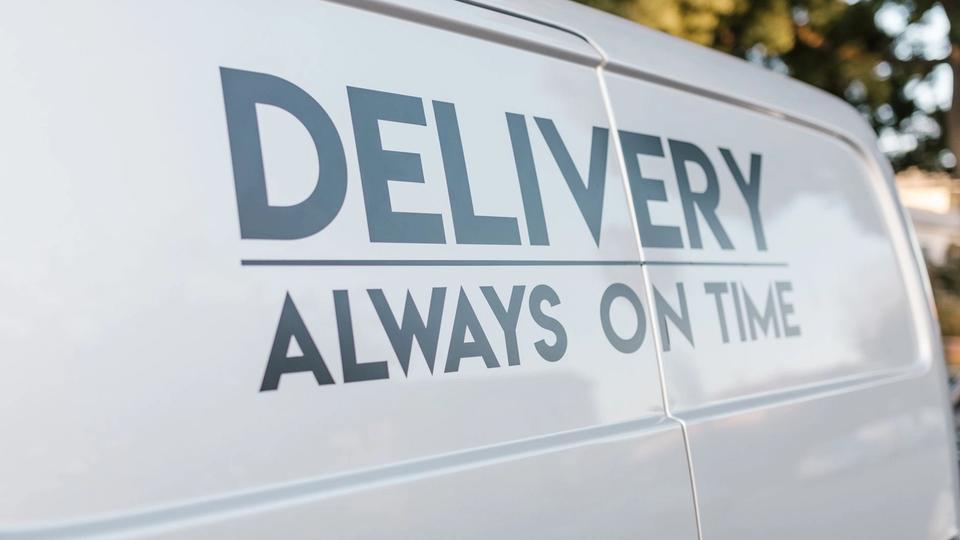
Most owners looking for a second phone number for business assume the new number becomes the business line. Usually the opposite is right: keep the number customers already have and take the new one for yourself. Beside can answer either, and port or forward the one you keep.
Your number is already on the truck
We answer calls for owners who have run their whole business on one phone number for years, and the pattern is the same every time: the number outlasts every other decision they have made. It is on the truck doors, the invoices and the yard signs, and in the contacts of everyone who has ever paid for the work.
The advice everywhere is to get a second number. That advice prices the app. The part that costs money is the change, and repainting a truck door is the smallest line item in it.
That is the exception case. Under the advice below you never repaint anything.
So which number moves?
For anyone with a few years of history, the answer runs against what every list assumes. The business keeps the number that is already published, and the new number becomes yours. The business stays where it is. The one who moves is you.
That works because the number you already have does not have to sit with your old carrier to be answered. Beside lists both routes on its pricing page: number porting, or call forwarding from existing carriers (Source: Beside pricing, 2026). Bring the existing line over, or forward the current business number and leave it where it is, with no porting and no downtime. New local or toll-free numbers get provisioned in the app the same day (Source: Beside, 2026), and that is the one you hand to your kid's school.
| New number goes to the business | New number goes to you (default) | |
|---|---|---|
| The truck, the signs, the cards | Re-letter and reprint | Nothing changes |
| Customers who dial the old number | Reach your personal phone, forever | Reach the business line, answered |
| Google Business Profile | Edit it, possibly re-verify | Leave it alone |
| Evenings | The old number still rings in your pocket | The business line is the one that is handled |
| Who has to be told | Everyone you have ever worked for | Family and friends |
Which route you pick is not a coin flip. If the number you publish is also the phone in your pocket, forward it: the line stays with your carrier, so your bank logins and every two-factor code keep landing where they always have, and Beside answers it anyway. Port it only if the business number is genuinely separate from your personal one.
The number stays where it is. What changes is what happens when it rings.
A second number splits the ringing
A second line buys one real thing: your personal number stops being public. It stops short of an answered phone. What it adds on its own is a second voicemail box to work through at nine at night.
The pricing is not the obstacle. Entry plans start around $9.99 a month for one number with a monthly minute allowance (Source: a provider's plan page, 2026), and unlimited-calling tiers run roughly $19 to $47 a month per user (Source: another provider's pricing page, 2026). Where an answering agent is bundled in at that level it is metered separately from the calling: one provider's own pricing page includes its agent on every tier with 1,000 credits, which the same page states is equal to ten calls.
“When you miss a call mid-session, you're just wondering if it's an emergency or they're just trying to book.” — Benjamin Wentworth, Audio Engineer and Founder of Mixing & Mentoring
The evaluating is the tax. With one line you cannot tell from the buzz whether it is a booking or a burst pipe, so every ring gets assessed. Splitting the numbers tells you which line rang, not what the caller wanted, and what a missed call actually costs decides whether that is enough.
What “answered” means on the line you keep
The number you keep can be the number that gets answered. Beside's receptionist answers, books and qualifies, transcribes and summarizes every call, and sends a daily recap of what came in (Source: Beside pricing, 2026). It runs 24/7 by default, including evenings, weekends and holidays (Source: Beside, 2026).
Texting comes with it, which matters if your customers thumb a message instead of calling. Calls and texts to the US and Canada are unlimited on the line (Source: Beside pricing, 2026), so the number they already have stays the number they text.
The honest limit: the line does not go dark at seven. What you set is your working hours, which govern when calls and notifications come through to you, and the app plays a different greeting outside those hours. The AI keeps picking up.
The difference is that picking up stops being your job, so a call at 8:40pm becomes a summary waiting for you, and dinner stays dinner. Darrell Everett, who runs a home-sharing operation in New York, put about four hours a week back that way, and describes waking up to the app comfortable that the AI picked up while he was not around.
What has to change if the number really does move
Sometimes the old number genuinely has to go: a shared family line, a partnership that ended, an area code from a city you left. Then the work is not in the app but in the places the number is published, one of which goes through Google's review queue.
Google's own documentation is plain about it: if you are asked for additional information to re-verify a profile, it is likely because business details were recently updated, and a verification review can take up to five business days (Source: Google Business Profile Help, 2026).
Before you change anything, write down where the number lives:
- The Google Business Profile and any other directory listing
- The header and footer of the website
- Invoices, estimates and quote templates
- The truck, the trailer, the yard signs
- Business cards, door hangers, fridge magnets
- Review site profiles
- The outgoing voicemail greeting, which says the old number out loud
That list is the real cost of moving a published number, and it is why the cheapest version of this decision repaints nothing.
What to set up, and what to skip
The feature matrix every second-number list ranks on is priced for a business with staff to route calls to. At one or two people, most of it is a maze you built for your own customers:
| Feature the lists rank on | Worth it at one or two people? |
|---|---|
| Extensions and department menus | No. There is no department. It adds a step in front of a human |
| Auto-attendant, “press 1 for sales” | No, unless calls genuinely split two ways |
| Toll-free vanity number | No. A local area code says you are nearby, which is the thing you are selling |
| A second physical phone | No. The second line is an app on the phone already in your pocket |
| Spam screening on the published line | Yes. Publishing a number is what puts it on call lists, and Beside flags suspected ones with a “Spam Likely” badge (Source: App Store, 2026) |
| A line that answers when you cannot | This is the one that changes the day |
What it costs, both ways
Start at the floor. The cheapest second number is free, and if all you want is to stop handing your personal cell to strangers, a free line does that job, though what it does with a call you cannot take is the whole of what you are buying above it.
Paid second lines start around $9.99 a month for one number and a 500-minute allowance (Source: a business-phone provider's plan page, 2026), about $120 for the year; how answering gets billed covers the metering. Beside is $29.99 a month, or $199.99 a year billed annually, with a 7-day trial, one line per user and extra lines at $4.99 a month (Source: Beside pricing, 2026).
So the ladder is $0 for a line that rings somewhere else, about $120 a year for a paid one with a minute cap, and $199.99 for one that answers. By our arithmetic on those published prices, that last step is about $80 a year, or roughly $6.70 a month, and it is the difference between knowing a call came in and having it handled. Darrell Everett, the home-sharing operator above, got about four hours a week back from voicemail that way.
The sign shop only enters the arithmetic in the exception case, where the published number genuinely has to move. One sign shop's 2026 price guide puts basic door lettering at $150 to $250 a side (Source: Blackout Signs & Graphics, 2026), and under the default it is money you never spend.
Setting it up without a gap in coverage
- Decide which number is the published one. For most owners with history, it is the one already on the truck.
- Forward it, or port it. Forwarding leaves the number with your carrier, which is what you want if it is also your personal phone.
- Take the new number yourself. Give it to family, your accountant, the school, the people who are not customers.
- Set your working hours and the after-hours greeting, then let the line answer.
Nothing on the truck changed, and the phone in your pocket is now yours. For what that looks like in practice, read how an audio engineer stopped taking calls mid-session.
PS — we're also building something new that takes on more of the loop starting with that call, and the waitlist for it is open now.