
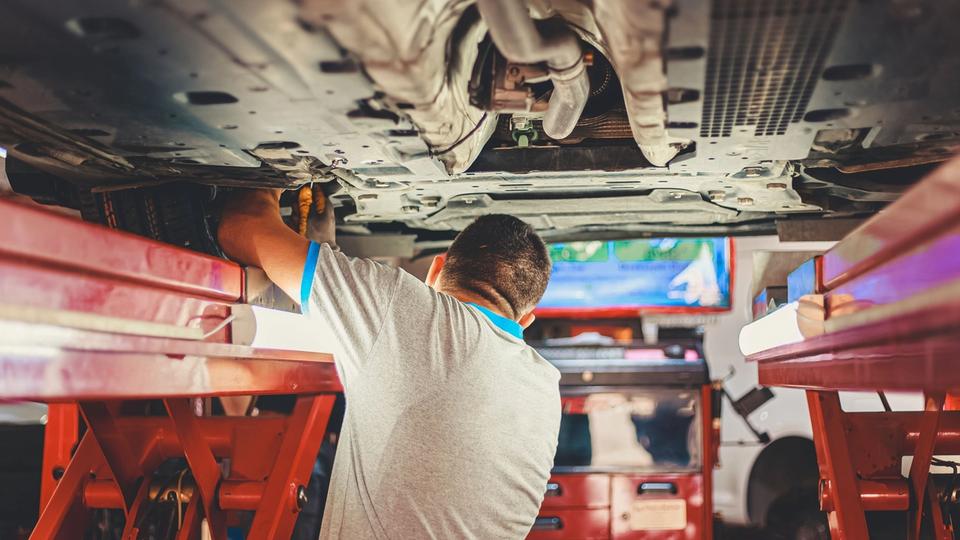
An answering service for an auto repair shop takes the calls you can't reach — not just after hours, but during them, when both hands are in an engine bay. Beside answers as your shop's line, books the appointment, and has the summary waiting before you wipe your hands.
We build the phone line small businesses answer with, and shops buying an answering service almost always buy the wrong one: coverage for the hours they are closed.
The call you miss isn't the one at 9pm
Every sales page in this category sells the same picture: the dead battery at ten at night, the weekend caller asking whether you work on Subarus. That is a dealership's problem.
An independent shop has a different problem. The phone rings at 10:40 on a Tuesday, a perfectly good time to call a mechanic, and nobody picks up, because the owner is elbow-deep in a timing cover with the phone on a toolbox two stalls over. He is not closed, he is working, and from the other end those look identical.
The caller hears four rings and a voicemail greeting. What he does next is the part the shop never sees.
What a missed call is actually worth in a repair shop
The instinct is to price a missed call as one job: a brake service, an alignment, a couple hundred dollars. A car is not a one-time purchase of your labor, it is a relationship with a machine that keeps breaking.
AAA puts maintenance, repair and tires at 11.04 cents per mile, and builds its cost tables on a 15,000-mile driving year (Source: AAA, 2025). By our math that is roughly $1,650 a year, per car. That is not one ticket, it is what a customer is worth annually to whichever shop answered the day his check engine light came on. There is more on what a missed call costs a small business behind that.
The fleet is on your side. The cars coming to you get older every year, and the heavy 2015 to 2019 registration years are rolling out of warranty into independent shops (Source: S&P Global Mobility, 2025). That work is growing, and it arrives the way old cars fail: a call from somebody whose car just did something new.
The caller standing next to a car that won't start
Most trades get a grace period. A roofer who misses a quote call can ring back at five and still win it.
A repair shop gets no window. AAA answered more than 30 million roadside events last year (Source: AAA Newsroom, 2026). Of the 27 million logged the year before, about three quarters were a tow or a dead battery (Source: AAA Newsroom, 2025).
Every one is somebody standing next to a car that will not move, holding a phone. He is not leaving a message. He works down a list of shops until one picks up, and the tow goes where the call is answered.
Joey Youssef runs NY Auto Broker, a brokerage rather than a repair shop, but he took 40 to 60 calls a week with one pair of hands and hit the identical wall.
"When one person calls, what happens when the second, third, or fourth call comes in?" — — Joey Youssef, NY Auto Broker
Calls do not queue politely. They arrive while you are on one, or under a car, and the ones you miss look exactly like the ones that never came.
Your line answers the next one while your hands are still busy.
Where the appointment actually lands
Beside books appointments, and it is worth being precise about where. The appointment lands in Beside, alongside the transcript and summary of the call that created it, and in your daily recap.
Beside does not publish a Google Calendar or Calendly integration. The booking, the transcript and the summary all live in Beside. To push it somewhere else, that is Zapier, plus about 17 direct integrations. More on how the booking works.
What comes back to you from a single call:
- The appointment, with the time the caller agreed to
- A transcript and a written summary
- The caller saved as a contact, so the next call knows him
- A "Spam Likely" badge on suspected spam
It doesn't plug into Tekmetric, and what that means for your tickets
Every page competing for this search leads with shop management compatibility: Tekmetric, Mitchell 1, Shopmonkey, Shopware. Beside integrates with none of them. Of its 17 direct connections, the two an independent shop is likely to run are QuickBooks and Square. Neither writes an RO.
If you came here to replace your shop software, do this instead
Keep writing repair orders where you write them now, and fix the step in front. The call gets answered, the customer gets booked, and the details arrive on your phone as text you read between jobs. The ticket still gets keyed in by whoever keys them today. The difference is there is a job to key in.
What it costs, and what an answering service costs
Extra lines are $4.99 a month, and the price is per user: an owner plus a service writer is two, not one. Worth knowing before checkout rather than at it.
The shape of that price is the point. A traditional answering service meters you by the minute or the call, so your busiest week produces your largest invoice. You get taxed for the thing you wanted.
| Beside | A traditional answering service | |
|---|---|---|
| Who answers | Your line, instantly, no hold music | An operator or a bot sitting in front of your number |
| What you pay | $16.67 per user/mo billed yearly ($29.99 monthly), flat | Metered by the minute or the call |
| Your number | Port it or forward it; callers keep dialing the same number | Sits in front of the number you already have |
| What you get back | Transcript and summary of every call, a daily recap, suggested actions | A message |
| Shop management system | None today (about 17 direct integrations, plus Zapier) | Varies by vendor |
Flat monthly, however busy the week gets.
We rank ours first because it is ours. See how it compares, or the pricing page.
The week the whole town's batteries die
The first hard freeze arrives and every marginal battery in the county gives up inside four days. Same in the first heat wave. Batteries are one of the two biggest reasons anyone calls for roadside help (Source: AAA Newsroom, 2025), and they do not fail politely spaced across a quarter.
Those are the weeks the phone is worth most and gets answered least, because the bays are already full. The owners we work with describe the same trap in every seasonal trade: the busier the week, the worse the answer rate. It is why shops with seasonal call spikes and the same problem in HVAC buy flat-rate coverage.
Is it worth it for a one-bay shop?
Yes, and more clearly than for a big one. If you are the owner, the technician and the phone, every call trades against billable work. Something that answers instantly, books the job and hands you a summary buys back the hour you cannot be in two places at once.
It is the wrong purchase for a shop with a service advisor at a counter all day inside Tekmetric, or anyone who needs the RO written by the thing that answers. Those shops should wait. Everyone else is choosing between a line that answers and a voicemail box, and voicemail is where repeat customers quietly go somewhere else.
One bay, one phone, and the week the batteries go is the week you can least afford voicemail.
PS — get started with Beside to bring your shop's calls and follow-ups together.
Sources: AAA, Your Driving Costs 2025, AAA Newsroom, April 2026, AAA Newsroom, April 2025, S&P Global Mobility, May 2025. Beside pricing and features verified on beside.com/pricing and beside.com/integrations, July 28, 2026. Hero photo: Pexels.